
Fri Sep 11 2026OurDestinations
Skiing Svalbard: A Seasoned Expedition Leader Shares Why and How
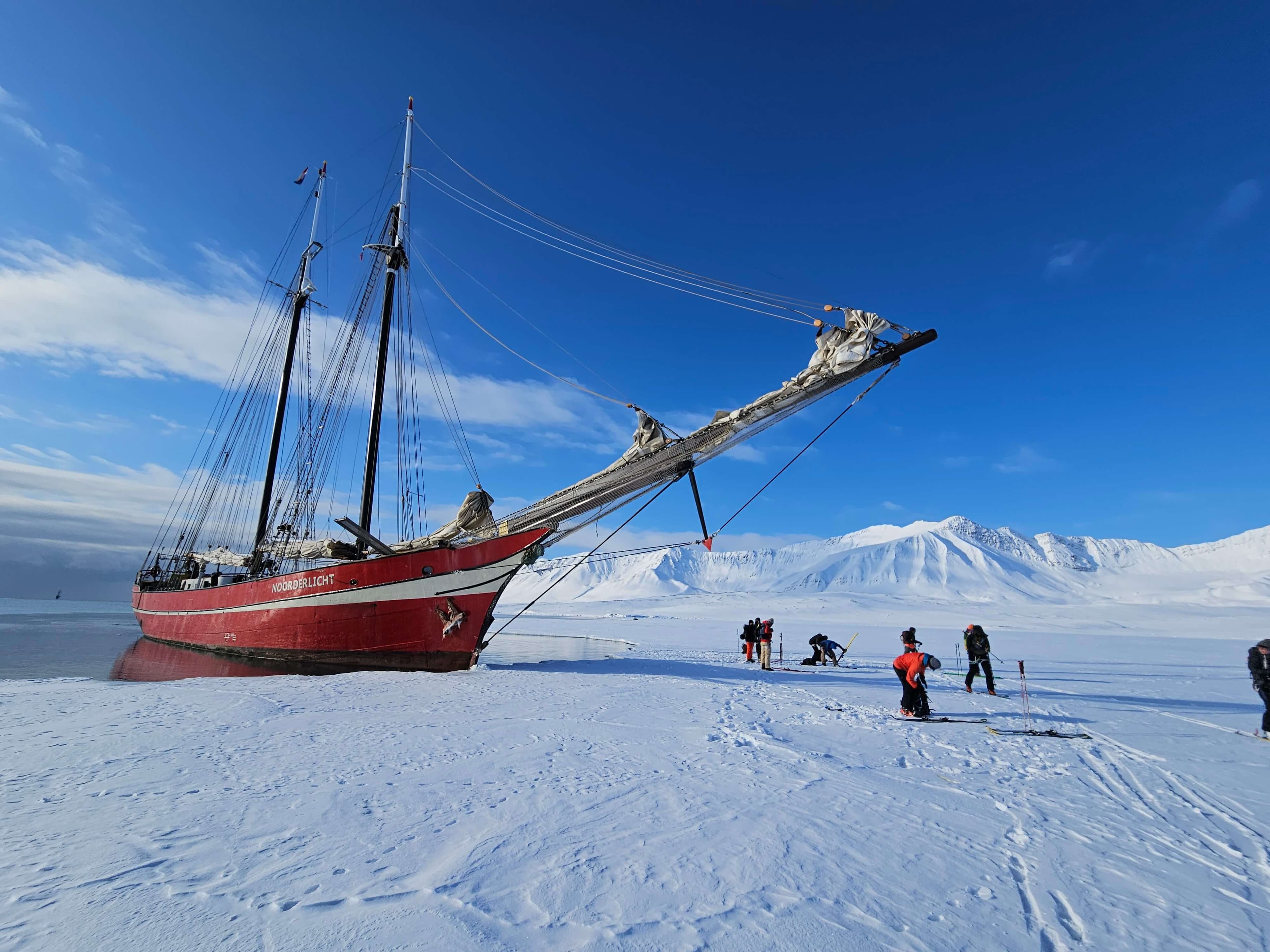
Set between Norway and the North Pole, the peaks of the Svalbard archipelago rise directly from the sea. Remote but easy to access, sail-to-ski trips here are defined by their incredible views, incredible lines, and wide-open Arctic terrain. Here, Tom Wolfe, founder of Sawback and a seasoned Svalbard expedition leader, shares why this unique island chain has become one of his favourite places to ski.
The first thing most people ask me is:
"Why Ski Svalbard?"
It's a fair question.
I've spent the better part of my life skiing and guiding in mountain ranges around the world. I've climbed and skied in the Canadian Rockies, Antarctica, Norway, Japan, and countless other places. So when people hear that I return to Svalbard year after year, often multiple times each spring, they're naturally curious.
What makes this remote Arctic archipelago so special?
Oddly enough, the answer isn't skiing.
Or at least, it's not just skiing.
Svalbard: The Land of Skiing and Stories
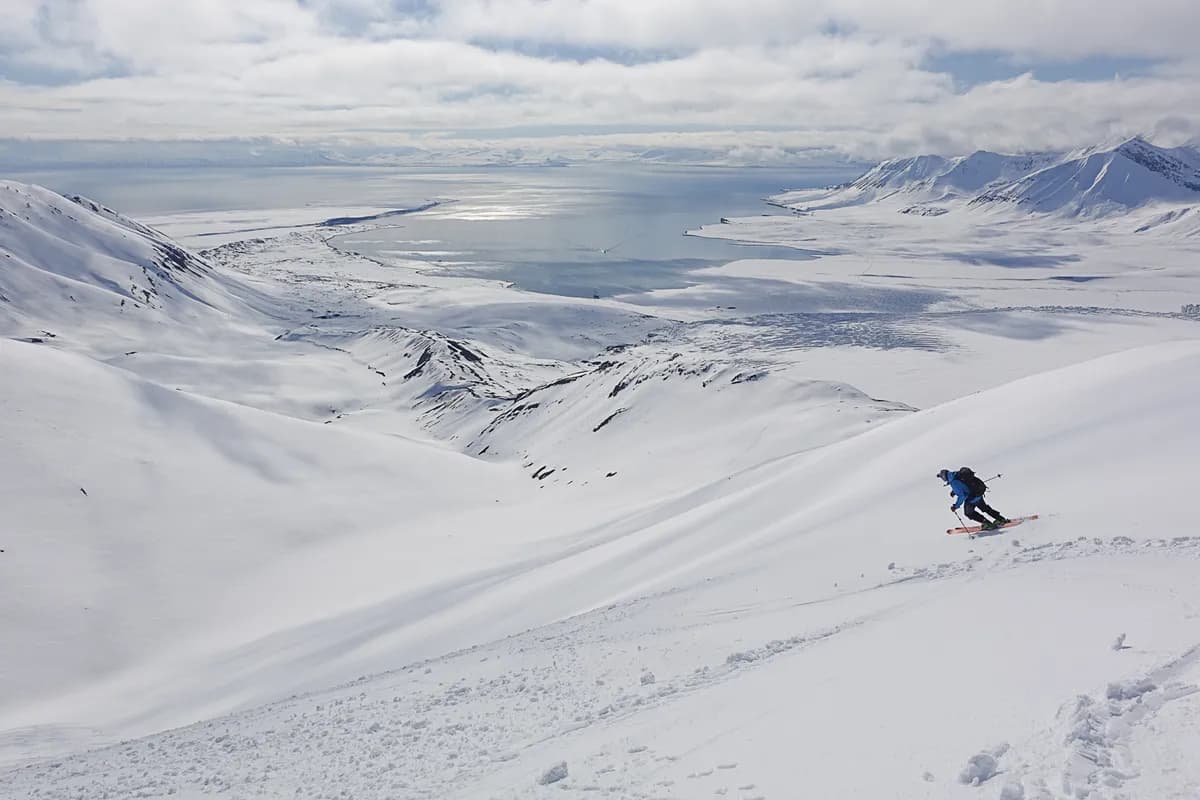
One of my favourite moments from Svalbard happened during a descent in St. Johnsfjord. I was skiing down toward the ocean when I caught movement out of the corner of my eye. Running alongside me was a small herd of Svalbard reindeer, effortlessly moving across the snow while glaciers spilled into the sea below.
A few hours later, I was standing on the deck of a sailboat beneath the midnight sun, watching icebergs drift past as we sailed toward our next objective.
That's Svalbard. It's a place where the skiing is incredible, but it's only one part of the story.
The wildlife, the glaciers, the endless daylight, the sailing, the feeling of true Arctic exploration. Those are the things that stay with people long after the trip ends.
In many ways, Svalbard reminds me of Antarctica. Both are lands of ice. Both feel wild and remote. Both offer the rare opportunity to travel through landscapes where nature still feels completely dominant.
But unlike Antarctica, Svalbard is surprisingly accessible.
A few hours after boarding a flight in Oslo, you can find yourself standing in Longyearbyen, one of the northernmost settlements on Earth, surrounded by glaciers, mountains, and Arctic wilderness.
For skiers looking for something beyond another resort vacation or another week in familiar mountains, Svalbard offers an experience that is increasingly difficult to find. Genuine adventure.
Most People Have Never Thought of Skiing Svalbard, And That's Part of the Appeal

To be honest, I didn't think much about skiing in Svalbard when I first heard about it.
A friend approached me nearly a decade ago with the idea of joining a ski-and-sail trip in the Arctic. My first reaction was skepticism. A small island chain in the Arctic Ocean? Living on a sailboat for a week? Potential seasickness? I wasn't exactly convinced it would become one of my favourite ski destinations.
Then I saw the photographs.
Glaciers spilling into fjords. Snow-covered peaks rising straight from the sea. Long descents ending at the water's edge. It looked unlike anywhere I'd ever skied before, so I decided to give it a chance.
By the end of that first trip, I was completely hooked.
What surprised me most wasn't the scenery, although it was spectacular. It wasn't even the skiing, despite some fantastic descents. It was the feeling that I wasn't simply on another ski trip. I was on an expedition. Even today, after decades of guiding around the world, I still think that's Svalbard's greatest strength.
A True Arctic Ski Expedition
Many ski destinations have become increasingly predictable. You fly into town, drive to your hotel, ski familiar terrain, and repeat the routine the next day.
Svalbard has never felt like that to me.
Every day feels exploratory. Every fjord seems to hide another objective, and every weather window opens up new possibilities. Even though Svalbard sits at nearly 80 degrees north latitude, it's surprisingly accessible, with regular flights connecting Longyearbyen to mainland Norway.
Ironically, once you're standing on a summit overlooking glaciers, sea ice, and endless mountain ranges, accessibility is the last thing on your mind.
The landscape feels vast, wild, and untamed.
That's what stays with me long after the trip is over. Not one particular ski run or a specific summit, but the feeling of exploring a place that still feels genuinely undiscovered.
In today's world, that's becoming incredibly rare.
What Makes Ski and Sail Svalbard So Different?
.jpg&w=3840&q=75)
Over the years, I've guided ski trips from Antarctica to Japan, from the Canadian Rockies to Norway. Every destination has its own character.
Japan has legendary powder. The Alps have history and scale. Canada’s backcountry lodges are winter gems. Antarctica has an expedition atmosphere unlike anywhere else on Earth.
But Svalbard offers a hybrid of both accessibility and wild arctic remoteness with a pairing of two amazing activities: sailing and skiing.
Many ski touring trips begin and end in the same place.
You stay in a lodge, a hotel, or a mountain hut. Every morning you head out into the mountains and every evening you come back to the same bed.
Ski and sail trips in Svalbard turn that model upside down.
Here, our basecamp moves. While we're sleeping, eating dinner, sharing stories, or simply watching the Arctic landscape pass by, the boat carries us toward new mountains and new objectives.
I think that's one of the reasons people fall in love with our Ski and Sail Svalbard trips so quickly. Every morning feels different.
Skiing Svalbard Means Every Day Is a New Adventure
One day we might wake up beneath a glacier-lined fjord with broad ski slopes rising directly from the shoreline. The next day we might be anchored beneath steep alpine peaks that seem to plunge straight into the ocean.
The flexibility is remarkable.
If conditions are better elsewhere, we move. If the weather looks promising in another fjord, we move. If we discover a beautiful anchorage surrounded by great ski terrain, we stay.
The boat allows us to adapt to conditions in a way that's simply not possible with a fixed lodge-based trip.
What’s the skiing like in Svalbard?
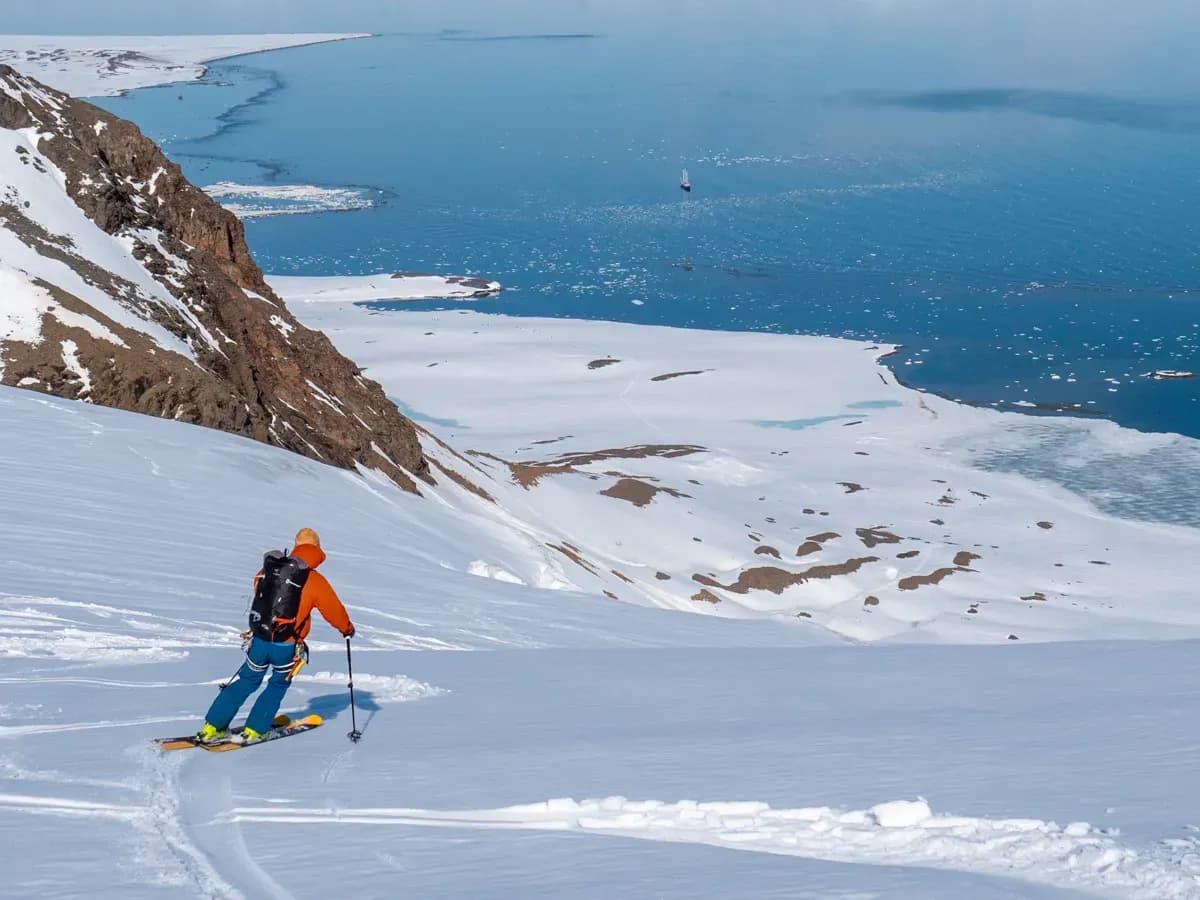
Then there's the skiing itself.
One of my favorite aspects of Svalbard ski touring is how directly the mountains connect to the sea.
In many mountain ranges, you're skiing through forests or descending into valleys. In Svalbard, you're skiing toward the ocean.
I'll never get tired of standing on a summit, looking down at a fjord thousands of feet below, and spotting our boat waiting at anchor.
From up high, it looks tiny. A small splash of colour against a landscape of ice, rock, and water. Then you click into your bindings and start skiing. A few minutes later, you're descending past glaciers and snowfields. A little later, you're crossing the shoreline. And before long, you're stepping directly from your skis back onto the boat.
Summit to sea.
There's something deeply satisfying about that.
Live Aboard the Sailboat on a Svalbard Ski & Sail Trip

I also think the sailing itself surprises people.
When guests first hear the words "ski and sail," many imagine rough ocean crossings and sleepless nights. To be honest, I had similar concerns before my first trip.
I distinctly remember thinking: "This sounds like a great way to get seasick."
What I discovered was exactly the opposite.
Much of our sailing takes place inside fjords and sheltered waters, where the mountains and surrounding landscape can provide some protection from larger swells.
For me, the result has usually been a remarkably comfortable experience.
In fact, some of the best sleep I've ever had has been aboard these vessels.
There's something about the gentle movement of the boat, the silence of the Arctic, and the absence of everyday distractions that allows people to truly relax. And that slower rhythm becomes part of the experience.
Some evenings we're watching glaciers drift past the windows. Other evenings we're gathered on deck watching seabirds circle above the cliffs. Occasionally we're simply sitting quietly, soaking in the fact that we're sailing through one of the most remote and beautiful places in the world.
The skiing may be what initially attracts people to Svalbard. But the sailing is often what makes the trip unforgettable.
Svalbard Wildlife: Encounters You Don't Get Anywhere Else
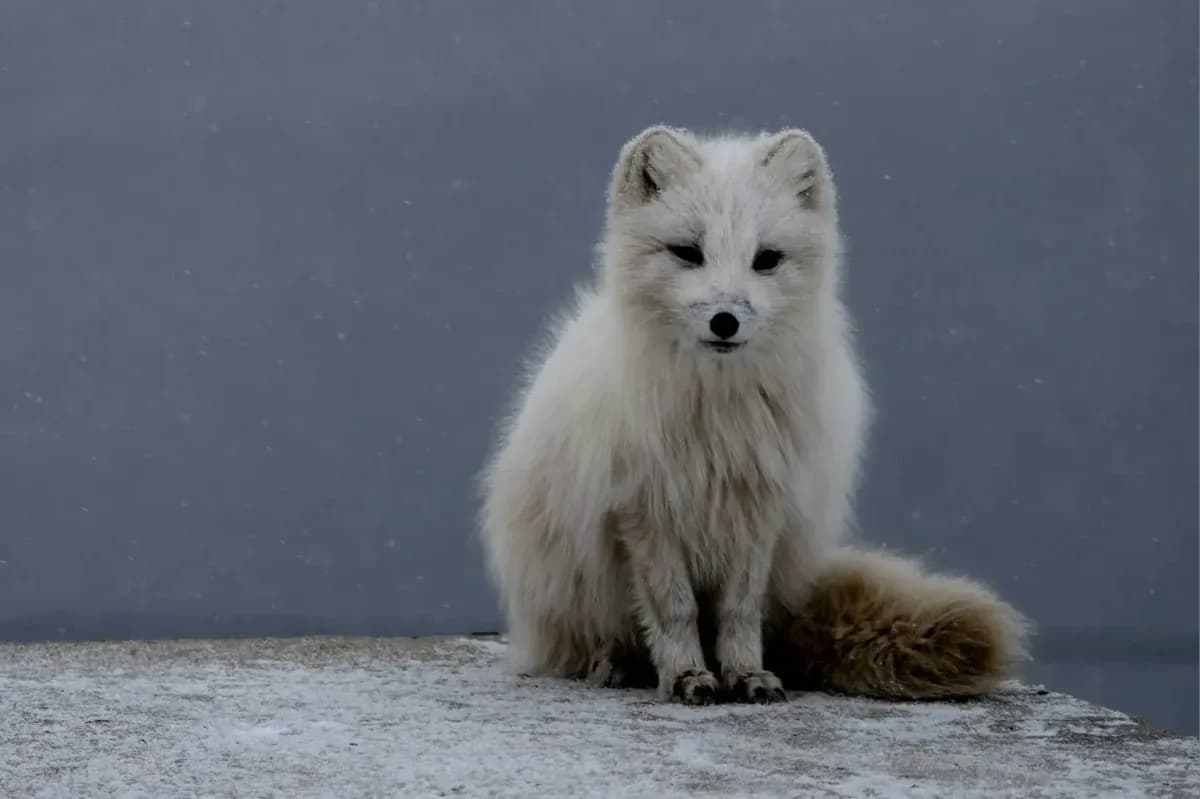
One of the biggest misconceptions people have about the Arctic is that it's empty. Nothing could be further from the truth.
The wildlife is actually one of the reasons I keep returning to Svalbard. I've been fortunate enough to ski in some extraordinary places throughout my career, but very few destinations combine skiing and wildlife in quite the same way.
Svalbard Reindeer: A Common Wildlife Sight on Ski & Sail Trips
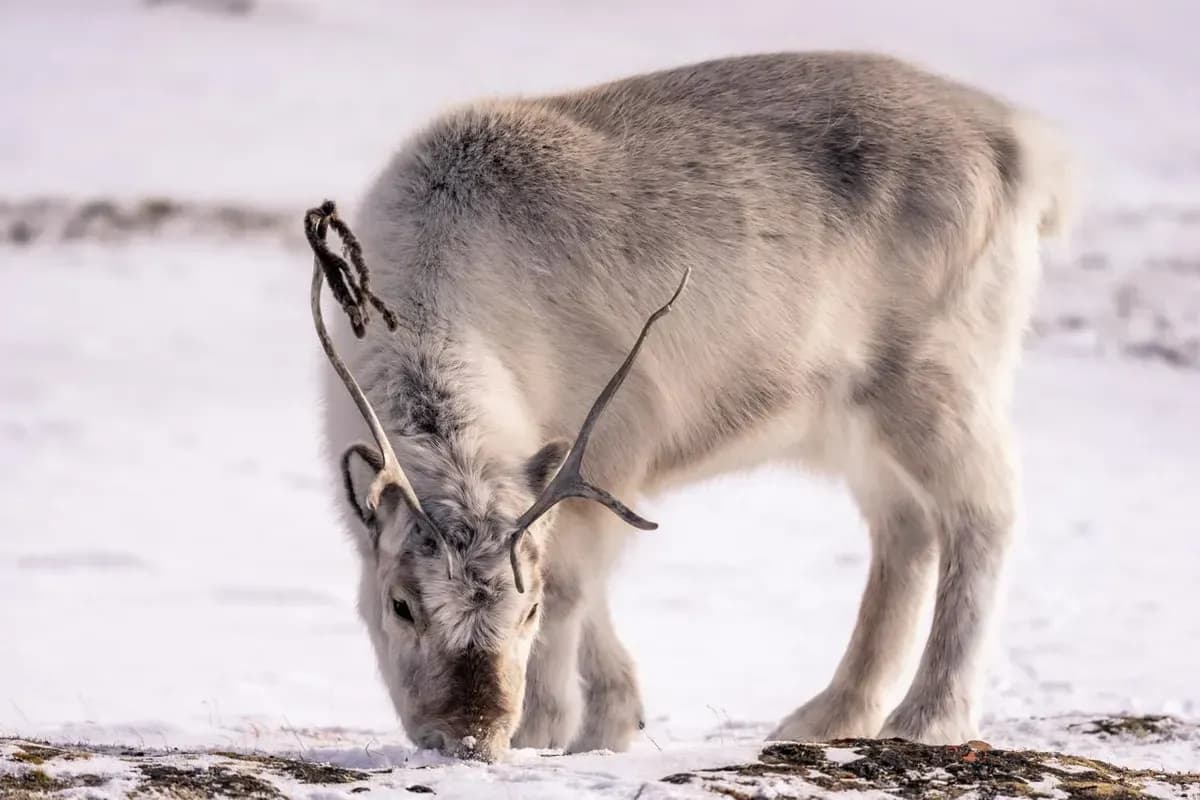
One of my favorite memories happened during a descent in St. John's Fjord. I was skiing toward the ocean when I noticed movement beside me. For a moment, I wasn't quite sure what I was looking at. Then I realized a small herd of Svalbard reindeer was running alongside me.
Not directly next to me, of course, but close enough that I could watch them moving effortlessly across the landscape while I skied downhill. It's one of those moments that reminds you you're a visitor in their world.
The Svalbard reindeer are fascinating animals. They're smaller and stockier than many of the caribou people are familiar with in North America. Over thousands of years, they've adapted to the harsh Arctic environment. They're also surprisingly charming.
From a distance, however, they occasionally create a moment of panic. Their pale coloration can look suspiciously similar to something else.
Polar Bear Spottings in Svalbard
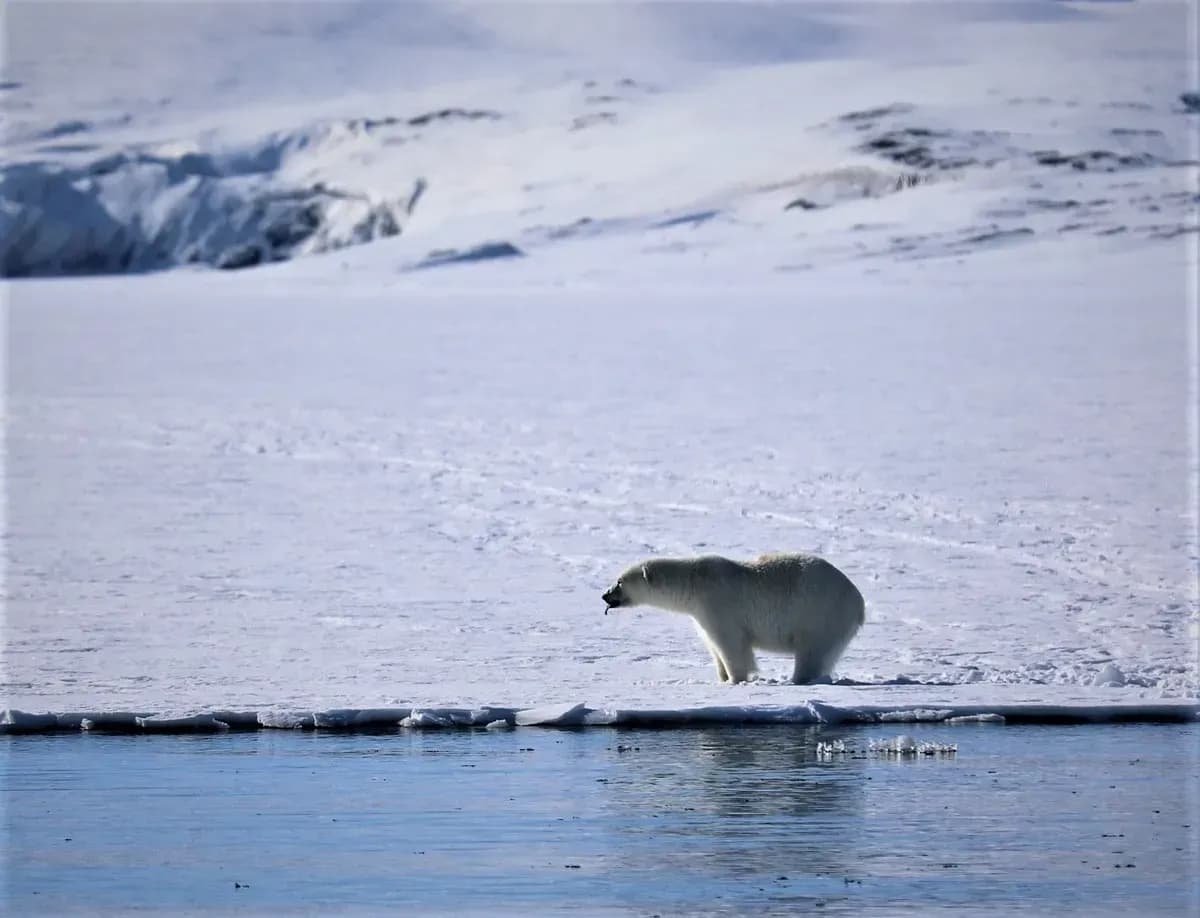
More than once I've caught movement out of the corner of my eye and briefly wondered if it was a polar bear. Fortunately, it's usually just a reindeer quietly grazing.
Polar bears, of course, are the wildlife species everyone associates with Svalbard. And yes, there are polar bears here. Lots of them.
That said, I always like to clarify expectations. These are ski touring expeditions, not polar bear viewing tours. We're here primarily to ski.
Most of the areas we travel through are chosen because they offer excellent ski terrain rather than because they maximize wildlife viewing opportunities. Still, we occasionally have the privilege of seeing bears.
One of the most memorable sightings I've experienced happened when we spent several hours observing a mother polar bear and her cub moving across the pack ice in the distance. Watching them interact in their natural environment was extraordinary.
Modern regulations require visitors to maintain significant distances from polar bears, which is absolutely the right approach. The goal is always to minimize our impact while respecting these animals and their habitat.
Even from a distance, they're incredibly impressive.
An Unexpected Wealth of Birds
Then there are the birds. Thousands upon thousands of birds.
As spring progresses, the cliffs around many fjords become alive with nesting colonies. Their calls echo across the water. Seabirds circle overhead while we're skiing.
Sometimes they accompany us all the way down toward the shoreline.
It's difficult to describe how alive the landscape feels. Many people arrive expecting a frozen wilderness. Instead, they discover a dynamic ecosystem filled with movement and life.
A Svalbard Midnight Sun Tour You'll Never Forget
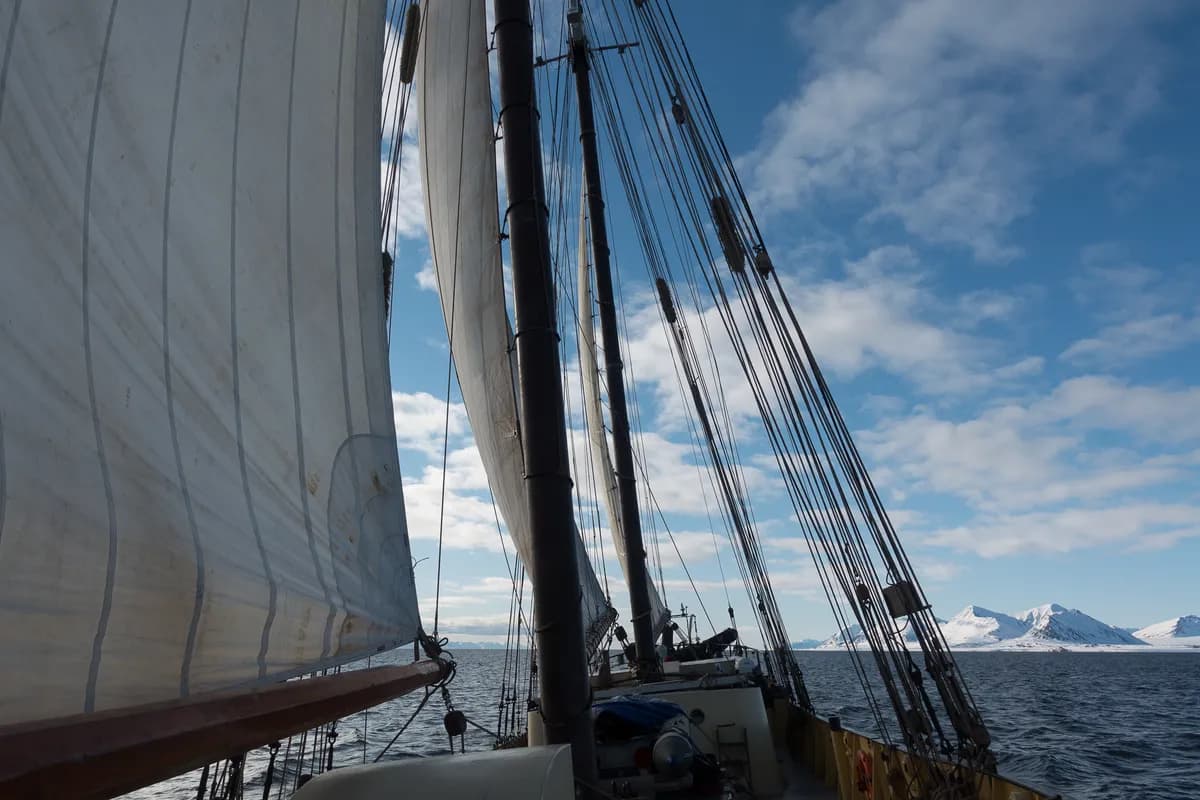
The farther north you travel, the stranger daylight becomes. By the time you reach Svalbard in spring, your normal understanding of day and night begins to disappear.
Starting in late April, the midnight sun arrives and the sun simply stops setting. If you've never experienced it before, it's difficult to appreciate how much that changes the rhythm of a trip.
What Is the Midnight Sun in Svalbard?
Back home, our days are dictated by daylight. We wake up with the sunrise, keep an eye on the clock throughout the afternoon, and eventually start thinking about getting back before dark. In Svalbard, that schedule simply doesn't exist.
I remember standing on deck one evening around midnight. The mountains glowed with soft golden light, the glaciers looked almost luminous, and the fjord was perfectly calm. The sun was still hanging above the horizon, and the whole scene felt almost impossible. Your brain knows it's midnight, but the landscape insists otherwise.
Why the Midnight Sun Makes Ski Touring in Svalbard Better
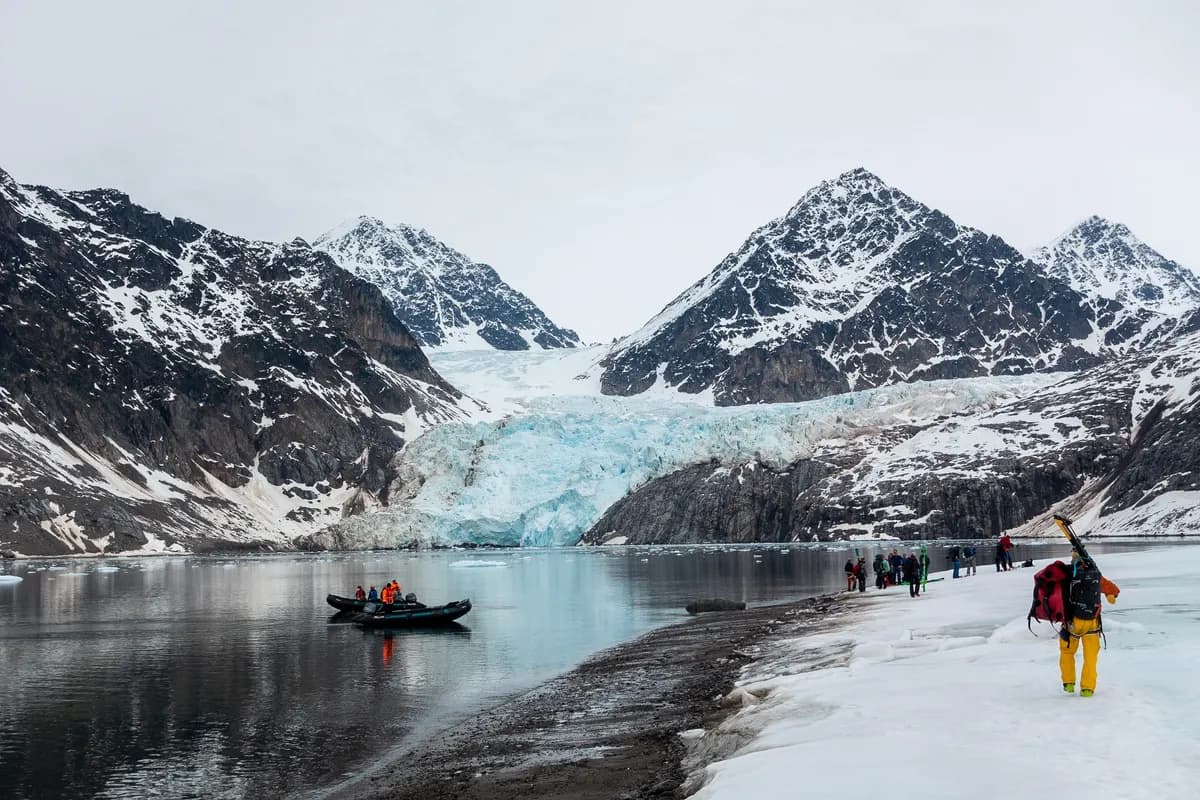
For skiers, those endless days are an incredible gift. There's no need to rush off a summit or worry about running out of daylight. We can wait for the snow to soften, enjoy lunch with a view, spend extra time taking photographs, or simply sit quietly and absorb the landscape. The light remains, hour after hour, giving us the freedom to experience the mountains at a much more relaxed pace.
The timing of the ski season also creates exceptional conditions. Although people often imagine brutal Arctic cold, spring in Svalbard is surprisingly comfortable. Most days fall somewhere between -5°C and +5°C—cold enough to preserve excellent snow, yet comfortable enough to spend long days outside. North-facing slopes often hold beautiful winter snow, while sunnier aspects transform into smooth spring corn.
For me, that's one of the reasons late April and May are the ideal time to visit. The combination of daylight, snow conditions, and access creates something truly special.
Evenings Under Svalbard’s Midnight Sun
Then there are the evenings—or perhaps I should say the "evenings." After dinner, many guests head back on deck. Not because they're hoping to catch the sunset—there isn't one—but because the constant Arctic light keeps drawing everyone outside.
The glaciers glow. Icebergs drift silently past. Mountains reflect perfectly across calm water, and the entire landscape seems suspended somewhere between day and night.
Years later, many guests struggle to remember individual ski runs. But they always remember standing beneath the midnight sun. That's an experience that stays with you.
Svalbard’s Landscapes Keep Skiers Coming Back
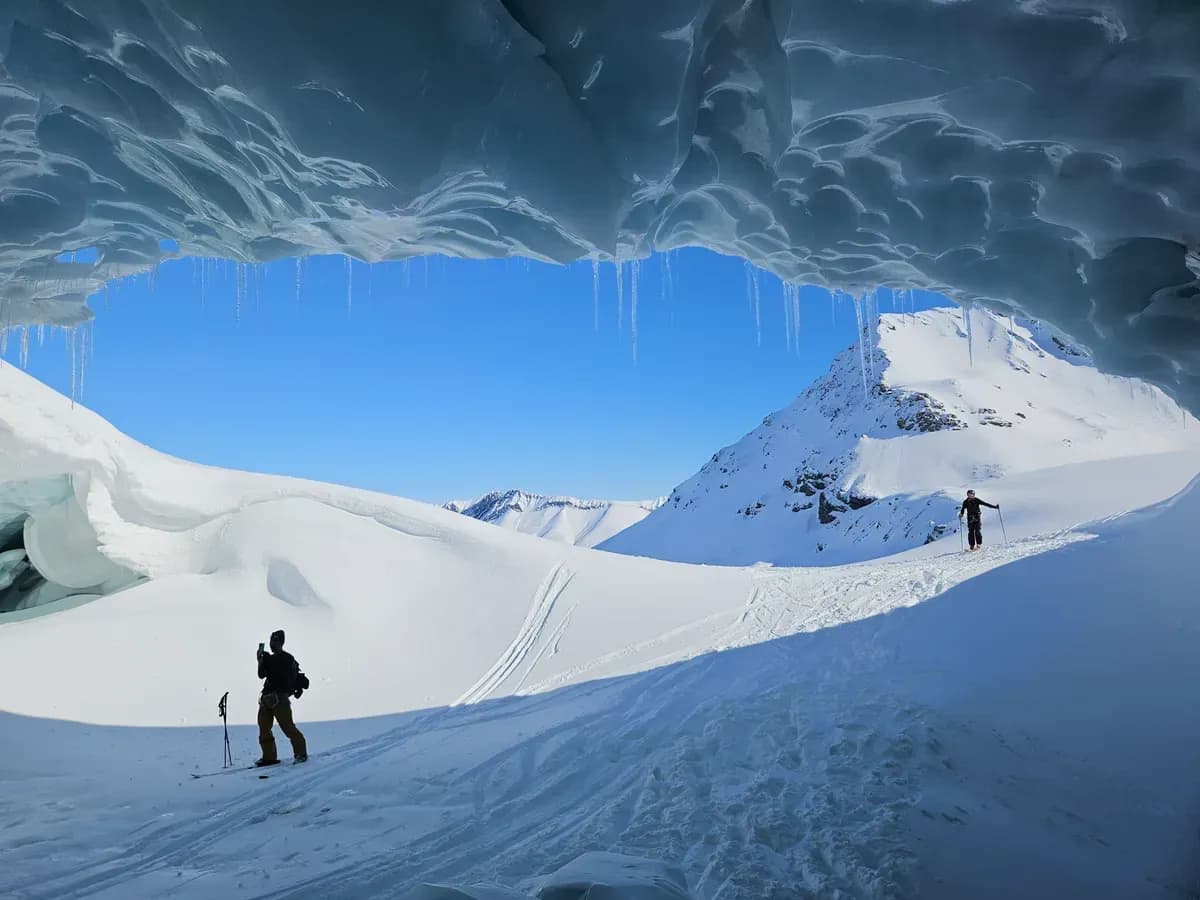
Over the course of my career, I've been fortunate enough to guide in some remarkable mountain environments. I've skied powder in Japan, crossed glaciers in the Canadian Rockies, climbed peaks in Antarctica, and explored mountain ranges throughout Scandinavia.
And yet there are still moments in Svalbard that stop me in my tracks.
Not because the mountains are necessarily bigger or the skiing is steeper, but because the landscape feels different. Rawer. More elemental.
Ski Touring Among Svalbard's Glaciers
One of my favorite places in Svalbard is Lilyhook Glacier. It's difficult to appreciate its scale until you're standing in front of it. The glacier stretches for kilometers through the fjord before terminating in the ocean, its towering walls of ice broken by deep crevasses, hanging seracs, and dramatic icefalls.
Sometimes we're sailing quietly through the fjord with small icebergs drifting past the hull. Everything is completely silent. Then, somewhere in the distance, you hear a deep crack echo across the water.
The glacier is moving.
Moments like that remind me these landscapes are alive—not in the biological sense, but in the geological one. Ice shifts. Glaciers advance and retreat. Sea ice breaks apart and reforms. Weather systems sweep through and transform entire valleys almost overnight.
Why Every Svalbard Ski Expedition Is Different
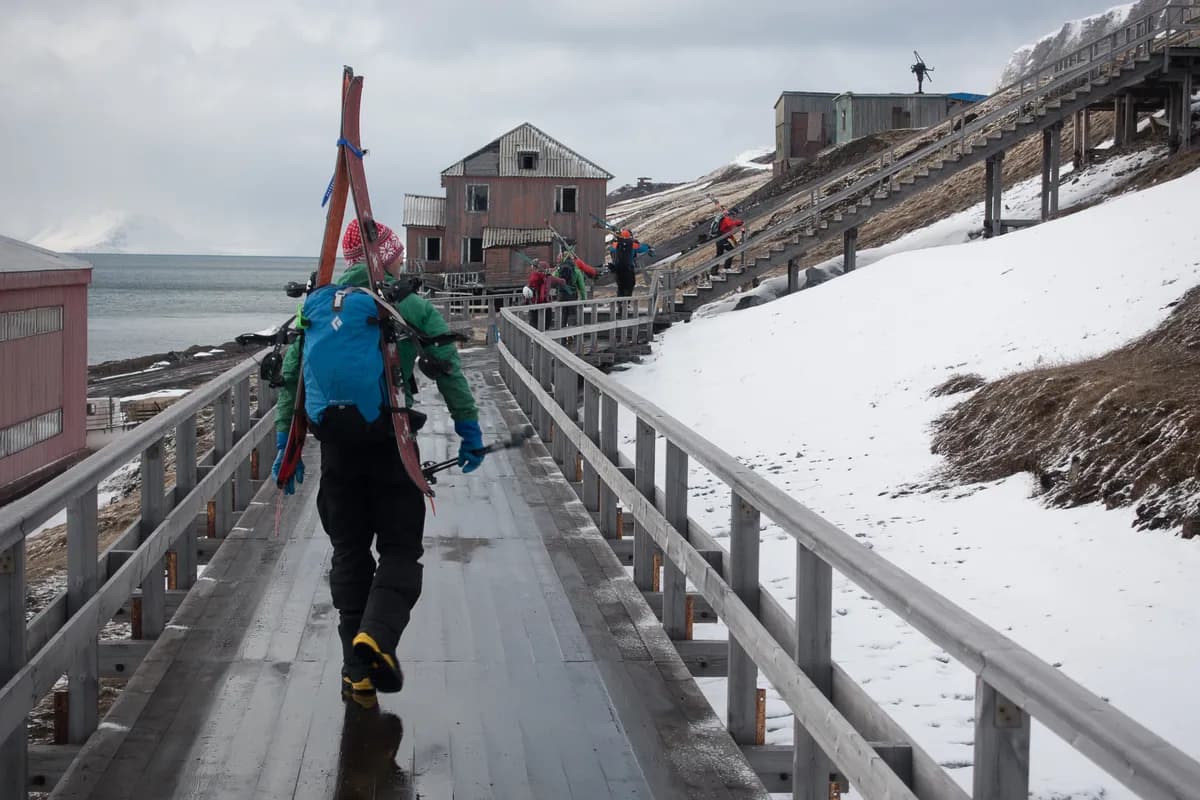
I think that's one of the reasons ski touring in Svalbard feels so powerful. Nothing here feels static.
One year a fjord may still be covered in sea ice, while the next it's completely open. One spring delivers exceptional powder, another offers perfect corn snow. Even after years of guiding here, the landscape never quite repeats itself.
That's one of the things I love most about leading a Svalbard ski expedition. No matter how carefully you plan, nature always has the final say. Every trip develops its own rhythm, its own conditions, and its own memorable moments.
Endless Mountains, Endless Possibilities
Another image that has stayed with me comes from a ski tour above Borrebukta. We climbed to a viewpoint overlooking what felt like an endless sea of mountains and glaciers. Every direction revealed another ridge, another glacier, another fjord disappearing into the distance.
I remember standing there and realizing that despite all the years I've spent exploring Svalbard, there were still countless valleys and summits I had never visited.
Borrebukta glacier is currently in a surge pattern and this past season the glacier pushed and spread forward into the sea and onto land hundreds of metres. Eerie spires of ice have risen and beside toppling debris dozens of metres above sea level. We were able to ski alongside of this phenomenon, taking note of the newer and ancient layers of ice and snow.
That sense of possibility is becoming increasingly rare.
Many mountain destinations become familiar over time. You learn the routes, recognize the terrain, and know what to expect before you even arrive. Skiing in Svalbard has never felt like that to me.
It continues to surprise me.
Even after all these years, I still find myself discovering new places, new ski lines, and new perspectives. And perhaps that's the highest compliment I can give any mountain destination.
Do You Need to Be an Expert Skier for Ski Touring in Svalbard?
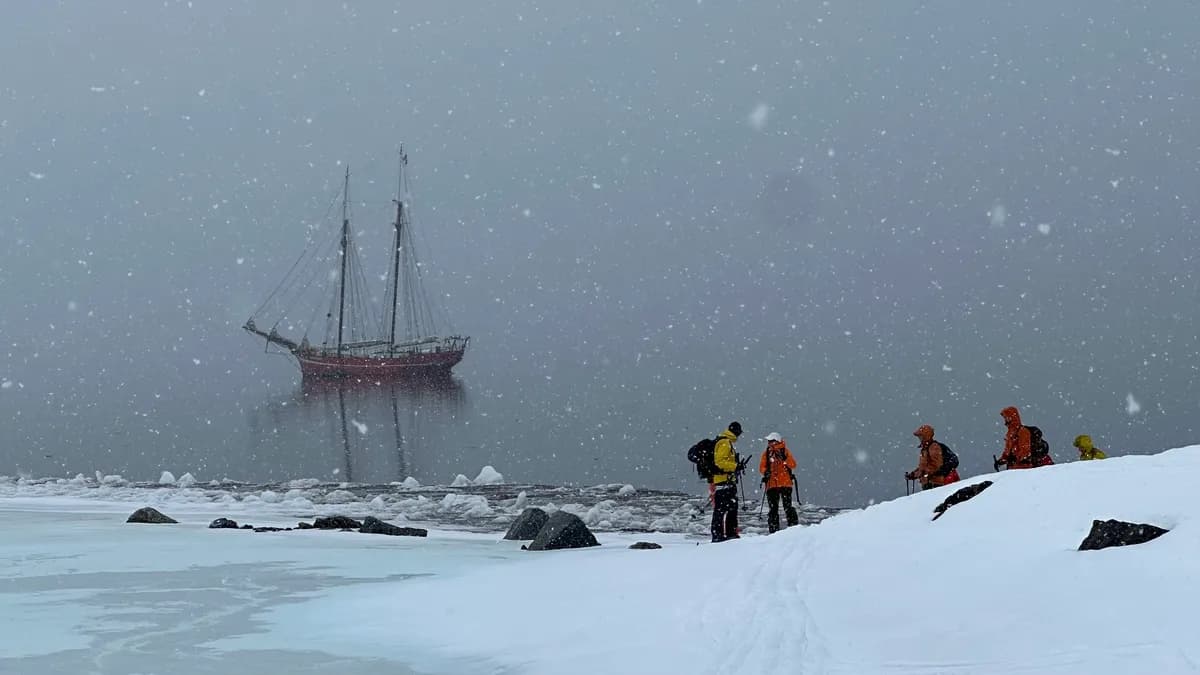
This is probably the question I get asked more than any other, and the answer usually surprises people.
No, you don't need to be an expert skier.
At least, not in the way many people imagine. When people hear words like Arctic, expedition, or ski mountaineering, they often picture elite athletes tackling impossibly steep terrain in extreme conditions. That's not what most ski touring trips in Svalbard are about.
What Ski Level Do You Need for Svalbard Ski Touring?
What I usually tell people is this: if you're a strong intermediate skier who's comfortable skiing black runs at a resort, you're already much closer than you think. The qualities I value most aren't necessarily technical skiing ability, but confidence, a reasonable level of fitness, and a willingness to learn.
Of course, stronger skiers generally have an easier time. They move more efficiently, they're often more comfortable in changing snow conditions, and they may have access to a wider variety of objectives. But skiing ability exists on a spectrum, and one of the advantages of guiding in Svalbard is that we can adapt to different experience levels.
How We Match the Day to the Group
On many of our trips, we have several guides working together, which allows us to divide into smaller groups and tailor each day to the people we're skiing with. Some guests are looking for a relaxed pace and shorter tours, while others are eager to climb a little higher, ski a little farther, and spend long days exploring the mountains.
Both approaches are equally rewarding. One of the things I enjoy most as a guide is helping everyone find terrain that matches their ability while still giving them the best possible Arctic experience.
Is Ski Touring Experience Required for Svalbard?
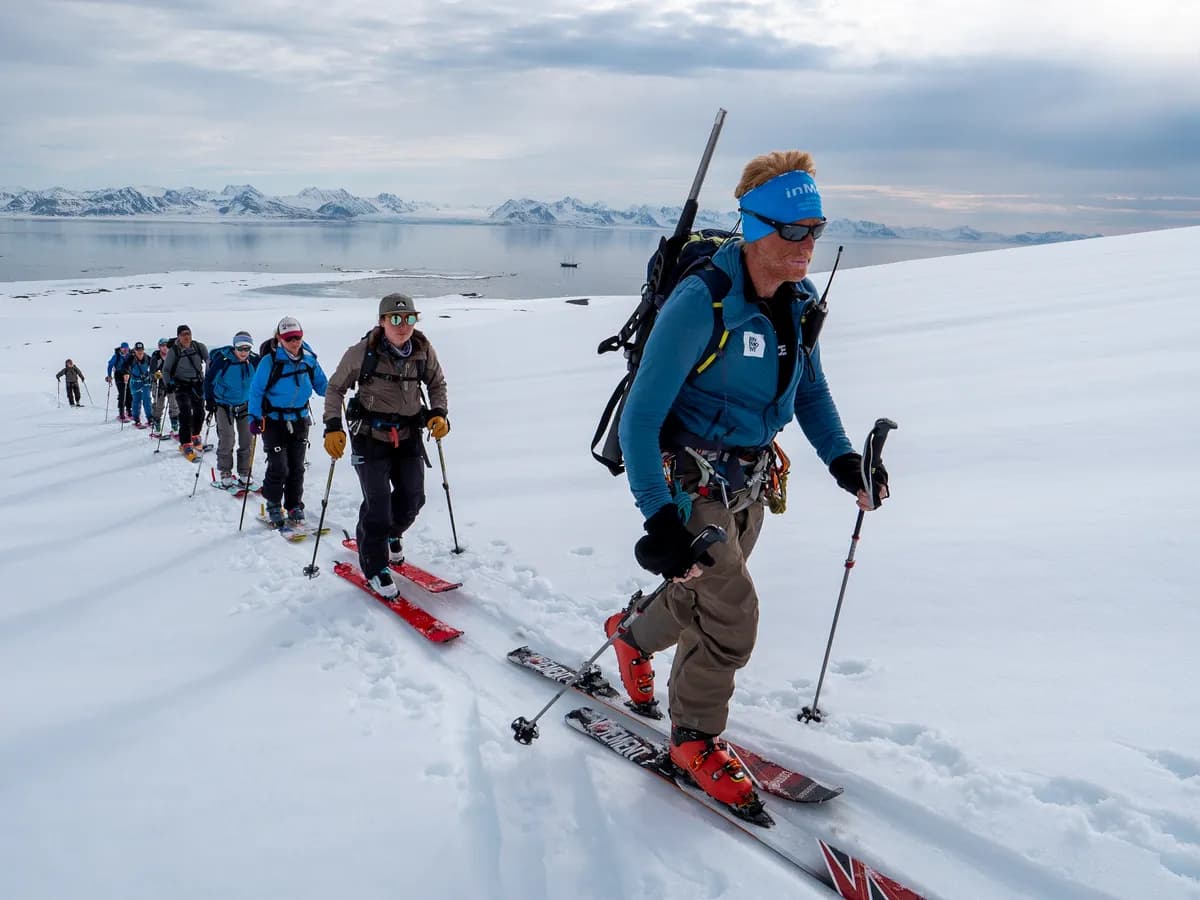
Another concern I hear quite often is: "I've never been ski touring before."
People worry about using climbing skins, transitioning between uphill and downhill mode, or learning kick turns. The good news is that those skills are relatively easy to teach. I can show someone how to use climbing skins in just a few minutes, transitions quickly become second nature, and with a little coaching, most people become comfortable with kick turns far faster than they expect.
What I can't teach during the trip is skiing ability or fitness. Those are the two things worth working on before you arrive. If you're confident skiing at a resort and you've spent a little time building endurance, you'll be in an excellent position to enjoy everything Svalbard has to offer.
Interestingly, many guests find the skiing here more approachable than they expected. Unlike the deep powder of western Canada or Japan, Svalbard often offers firmer, more consistent snow conditions. For skiers who have spent years on groomed slopes, that can actually feel surprisingly familiar.
My goal has never been to create the hardest ski trip possible. It's to help people safely explore one of the most extraordinary landscapes on Earth.
What a Typical Day Looks Like on a Svalbard Ski and Sail Trip
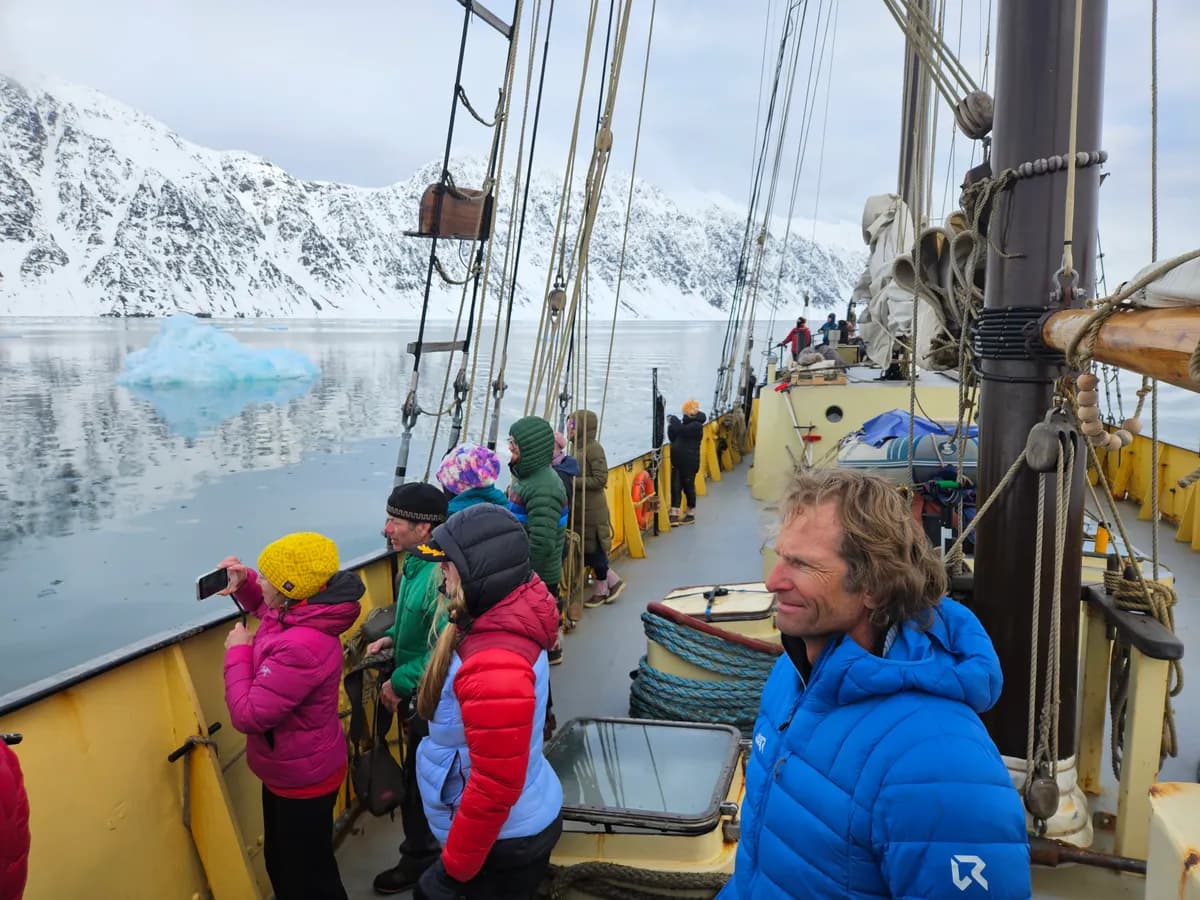
One of the hardest things to explain before people arrive is what daily life on a ski and sail Svalbard trip actually feels like. Most skiers have experienced hut trips or stayed in mountain lodges, but very few have combined sailing and ski touring. That's what makes the experience so unique.
Waking Up in a New Corner of the Arctic
Every morning begins a little differently. You wake up aboard the boat and look outside your cabin window. Perhaps you're anchored beneath a glacier, tucked into a quiet fjord surrounded by snow-covered peaks, or maybe the boat has sailed overnight and you've arrived somewhere completely new while you were asleep.
That sense of waking up to a different landscape every day never really gets old.
After breakfast, the guides gather everyone together to discuss the day's plan. We'll look at the weather, avalanche conditions, snow quality, group energy levels, and the different ski objectives available before deciding where the day will take us.
Ski and Sail Svalbard Is All About Flexibility
One of the biggest advantages of ski-and-sail travel is that we're never locked into a single itinerary. If conditions look better in another fjord, we simply sail there. If the weather changes, we adapt. If we discover a beautiful objective that wasn't part of the original plan, we have the freedom to explore it.
That flexibility is something I value enormously as a guide because it allows us to make decisions based on the mountains rather than a schedule. Nature dictates our plans—not the other way around.
From Summit to Sea
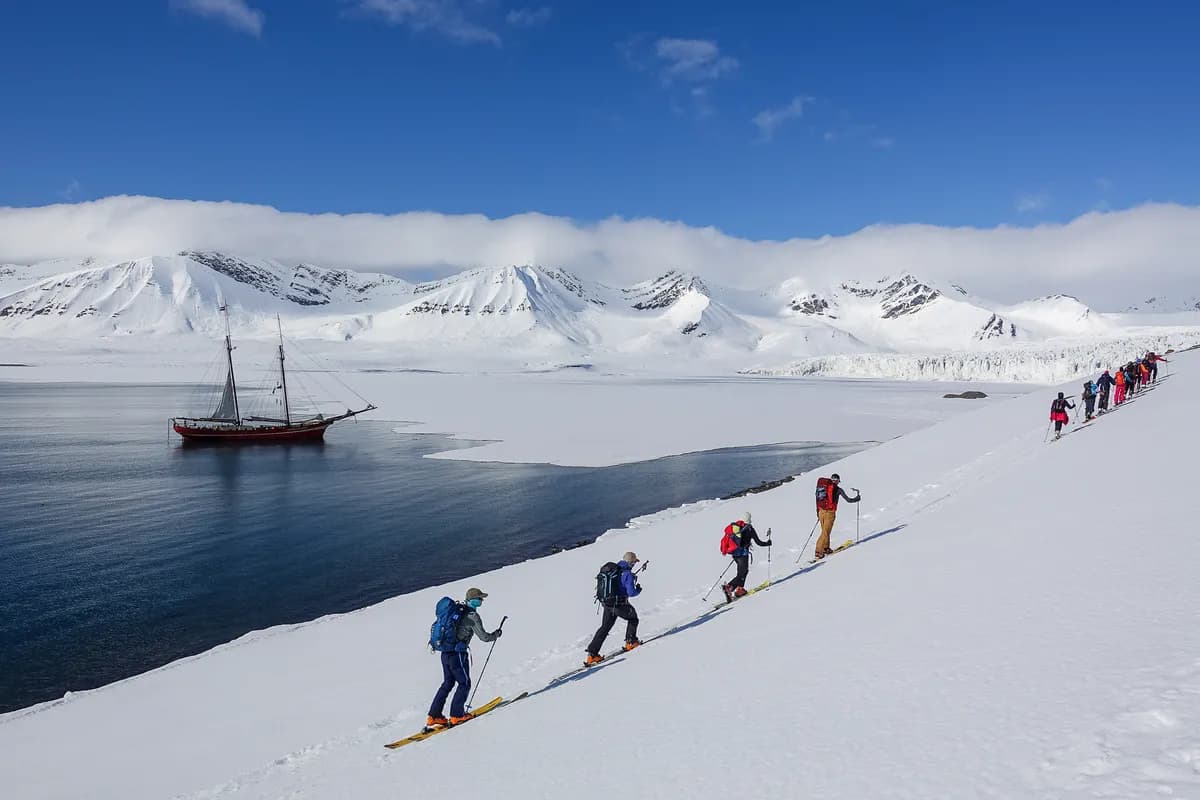
Once we're ashore, the rhythm becomes familiar to anyone who enjoys ski touring. We climb steadily through the mountains, chatting as we go and stopping occasionally to admire the scenery. As we gain elevation, the perspective changes dramatically. The fjord grows smaller below us, the boat becomes a tiny speck on the water, glaciers appear around every corner, and sometimes wildlife does too.
There are days when we won't see another person from the moment we leave the boat until we return in the afternoon. That kind of solitude has become increasingly rare. It's not lonely—it's peaceful.
At the summit, we take our time. I've never believed in rushing mountain experiences, especially in a place like Svalbard. The views deserve attention, and so does the scale of the landscape. Eventually comes the reward: a long descent that often carries us all the way back to the shoreline, where the boat is waiting.
Very few ski destinations allow you to finish your run at sea level.
Evenings Aboard the Expedition Boat
Back aboard the boat, the pace slows again. People sort through photographs, relax with a book, watch for wildlife from the deck, or simply enjoy watching glaciers and mountains drift by outside the windows.
Dinnertime is always a highlight. Everyone gathers around the table to enjoy delicious chef prepared meals, share stories from the day's skiing, compare photographs, and speculate about tomorrow's objectives. Those conversations are often just as memorable as the skiing itself.
Looking back, I think that's what makes Ski and Sail Svalbard so special. Of course, the skiing is exceptional, but it's the rhythm of the trip that stays with people. The constant movement, the exploration, and the feeling that every day reveals another corner of the Arctic create an experience that's difficult to replicate anywhere else.
For one week, the boat becomes home. By the time we sail back into Longyearbyen, most people aren't quite ready to leave.
Commonly Asked Questions About Skiing in Svalbard, Norway
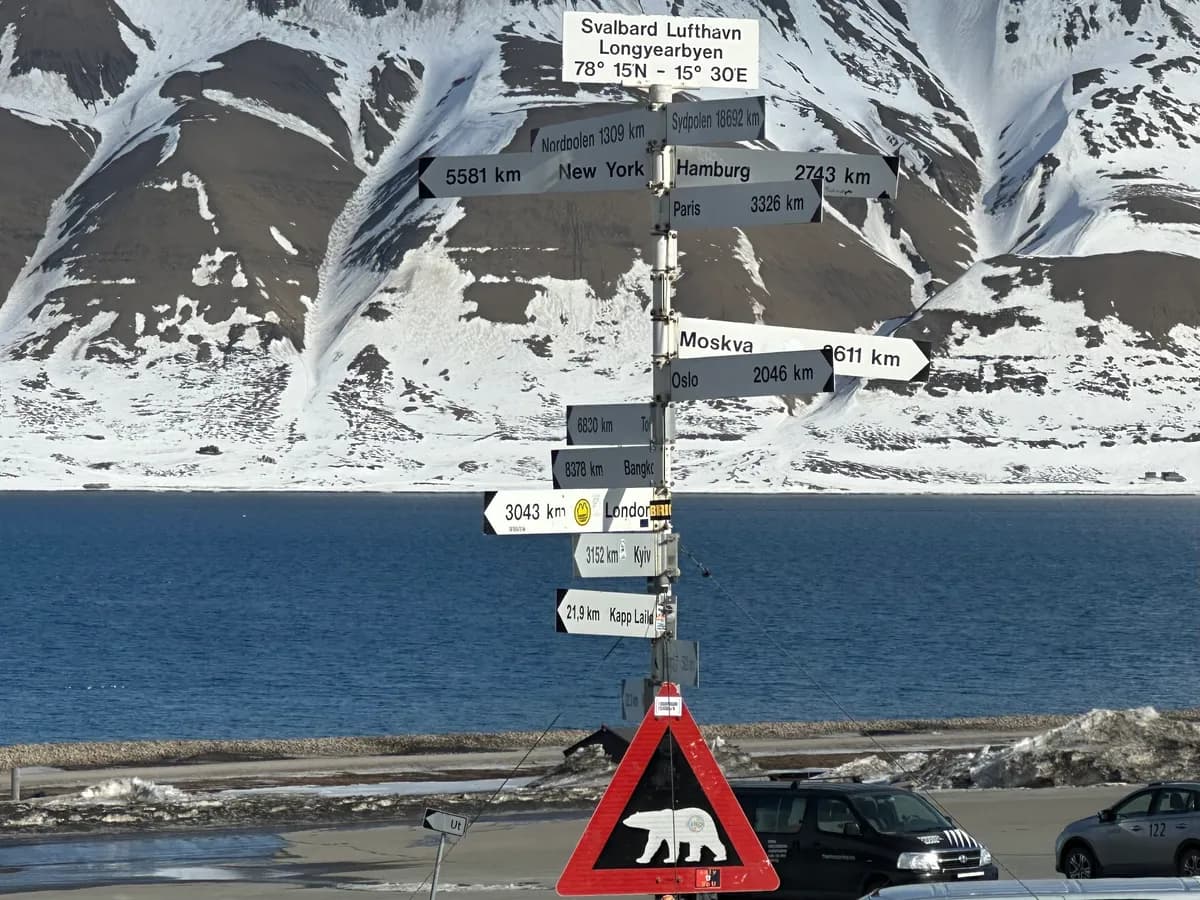
Where Is Svalbard?
Svalbard is a Norwegian archipelago located roughly halfway between mainland Norway and the North Pole.
The largest island is Spitsbergen, which is where most ski touring and ski-and-sail expeditions take place.
Although Svalbard feels incredibly remote, it is surprisingly accessible and connected to mainland Norway by regular flights.
Its location at nearly 80 degrees north latitude makes it one of the northernmost inhabited regions on Earth.
For many visitors, simply traveling this far north is part of the appeal.
How Do You Get to Svalbard?
Most travelers reach Svalbard by flying through Oslo Airport.
From Oslo, direct flights connect to Svalbard Airport in Longyearbyen, the largest settlement in the archipelago.
The flight takes approximately three hours.
One of the things that surprises many guests is how straightforward the journey actually is.
Compared to destinations like Antarctica, Greenland, or many remote mountain ranges, getting to Svalbard is remarkably easy.
I usually recommend arriving at least a day early. Better yet, spend a few extra days exploring Longyearbyen and skiing around town before joining your expedition.
It helps with travel logistics and provides a fascinating introduction to life in the High Arctic.
How Can You See Polar Bears in Svalbard?
Polar bears live throughout Svalbard, but it's important to understand that ski touring trips are not dedicated wildlife-viewing expeditions.
We occasionally see polar bears during our travels, particularly while sailing between fjords or observing distant pack ice. However, sightings are never guaranteed.
Current regulations require visitors to maintain significant distances from polar bears, helping protect both the animals and visitors.
If you're fortunate enough to encounter one, even from afar, it's an unforgettable experience.
When Should You Visit Svalbard?
For ski touring, I believe the best period runs from mid-April through late May.
This timeframe offers an ideal combination of:
- Excellent snow conditions
- Long daylight hours
- Access to the fjords by boat
- Comfortable spring temperatures
- Opportunities to experience the midnight sun
Earlier in the season, sea ice can restrict access to certain areas.
Later in the season, changing snow conditions and environmental regulations limit some of the opportunities that make ski-and-sail trips so special.
For most skiers, late April and May provide the best overall experience.
What Can You Do in Svalbard Besides Skiing?
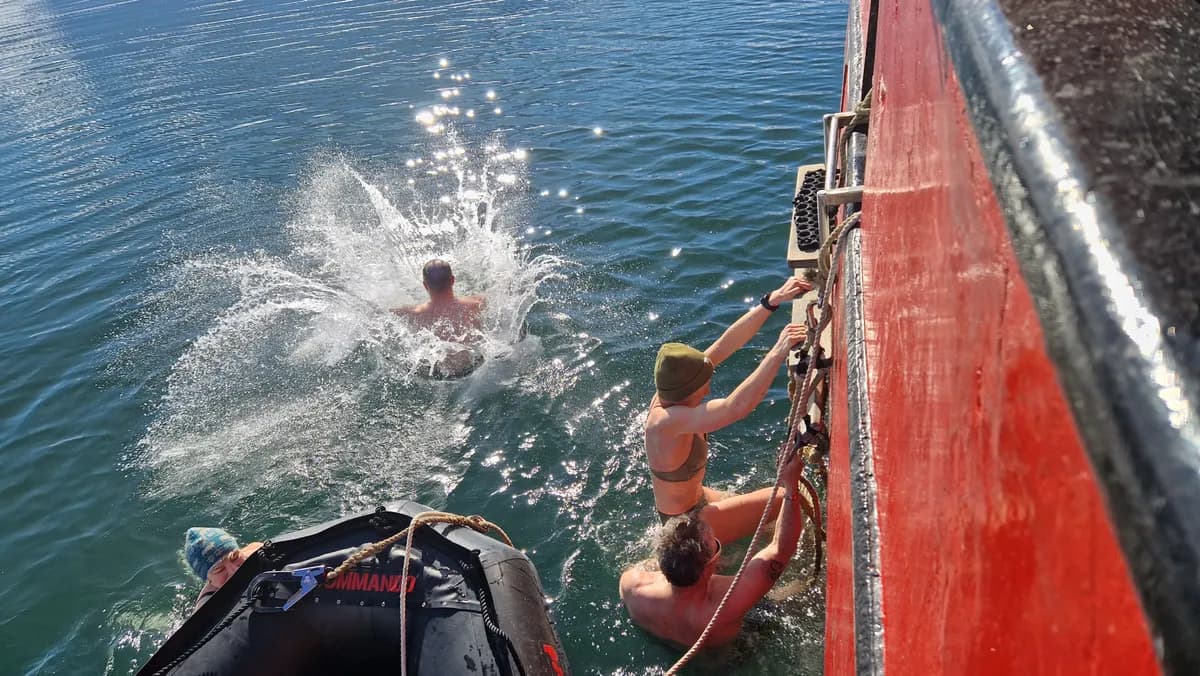
Quite a lot, actually.
Many people arrive expecting a ski trip and leave talking just as much about everything else.
Here are just a few options:
- Wildlife viewing
- Photography
- Glacier exploration
- Sailing through Arctic fjords
- Visiting Longyearbyen
- Learning about Arctic history
- Observing seabird colonies
- Experiencing the midnight sun
- Polar dipping
One of the reasons Svalbard appeals to non-skiing partners and family members is that the destination itself is so fascinating.
Even without skis, it's an extraordinary place to visit.
Where Should You Stay in Svalbard?
Most visitors spend at least one night in Longyearbyen before or after their expedition.
Personally, I recommend spending a little extra time in town whenever possible.
Longyearbyen has a fascinating history and a unique Arctic atmosphere.
What Should You Pack for a Svalbard Ski Tour?
The essentials I always recommend on my trips are:
- Ski touring skis or splitboard
- Climbing skins
- Avalanche safety equipment
- Ski crampons
- Warm layering system
- Waterproof outerwear
- A very warm down jacket (paired with down pants is extra nice)
- Glacier harness
- Gloves and spare gloves
- Sunglasses and goggles
- Sunscreen
- Small binoculars (optional, but highly recommended)
One thing people often underestimate is how enjoyable time on deck can be.
Having warm clothing for sailing portions of the trip makes a huge difference.
A good down jacket quickly becomes one of the most appreciated pieces of equipment you'll bring.
Is Skiing Svalbard Worth It? Absolutely.
.jpg&w=3840&q=75)
After decades of guiding around the world, I've learned that truly special places are rare.
Many destinations offer incredible skiing. Others have spectacular scenery or unforgettable wildlife. Svalbard is one of the few places that brings all of those things together.
Here, you can ski from glaciers to the ocean, watch reindeer cross the tundra, sail between towering fjords, and stand beneath the midnight sun long after your watch says it's time for bed. Every day feels like a new expedition, and every season reveals something different.
That's why I keep coming back.
Not because I've seen everything Svalbard has to offer, but because I haven't.
And I hope that after experiencing it yourself, you'll understand exactly what I mean.